3197. Find the Minimum Area to Cover All Ones II
Hard63.6% acceptance64,941 / 102,181 submissions
Asked by 4 companies
Topics
You are given a 2D binary array grid. You need to find 3 non-overlapping rectangles having non-zero areas with horizontal and vertical sides such that all the 1's in grid lie inside these rectangles.
Return the minimum possible sum of the area of these rectangles.
Note that the rectangles are allowed to touch.
Example 1:
Input: grid = [[1,0,1],[1,1,1]]
Output: 5
Explanation:
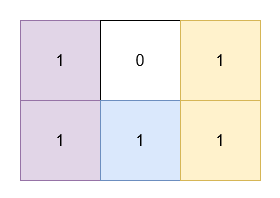
- The 1's at
(0, 0)and(1, 0)are covered by a rectangle of area 2. - The 1's at
(0, 2)and(1, 2)are covered by a rectangle of area 2. - The 1 at
(1, 1)is covered by a rectangle of area 1.
Example 2:
Input: grid = [[1,0,1,0],[0,1,0,1]]
Output: 5
Explanation:
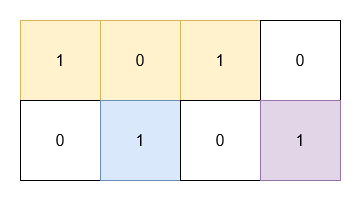
- The 1's at
(0, 0)and(0, 2)are covered by a rectangle of area 3. - The 1 at
(1, 1)is covered by a rectangle of area 1. - The 1 at
(1, 3)is covered by a rectangle of area 1.
Constraints:
1 <= grid.length, grid[i].length <= 30grid[i][j]is either 0 or 1.- The input is generated such that there are at least three 1's in
grid.
Hints
Hint 1
Consider covering using 2 rectangles. As the rectangles don’t overlap, one of the rectangles must either be vertically above or horizontally left to the other.
Hint 2
To find the minimum area, check all possible vertical and horizontal splits.
Hint 3
For 3 rectangles, extend the idea to first covering using one rectangle, and then try splitting leftover ones both horizontally and vertically.