2074. Reverse Nodes in Even Length Groups
Medium63.7% acceptance44,621 / 70,018 submissions
Asked by 6 companies
Topics
You are given the head of a linked list.
The nodes in the linked list are sequentially assigned to non-empty groups whose lengths form the sequence of the natural numbers (1, 2, 3, 4, ...). The length of a group is the number of nodes assigned to it. In other words,
- The
1stnode is assigned to the first group. - The
2ndand the3rdnodes are assigned to the second group. - The
4th,5th, and6thnodes are assigned to the third group, and so on.
Note that the length of the last group may be less than or equal to 1 + the length of the second to last group.
Reverse the nodes in each group with an even length, and return the head of the modified linked list.
Example 1:

Input: head = [5,2,6,3,9,1,7,3,8,4]
Output: [5,6,2,3,9,1,4,8,3,7]
Explanation:
- The length of the first group is 1, which is odd, hence no reversal occurs.
- The length of the second group is 2, which is even, hence the nodes are reversed.
- The length of the third group is 3, which is odd, hence no reversal occurs.
- The length of the last group is 4, which is even, hence the nodes are reversed.
Example 2:
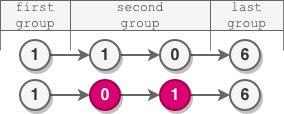
Input: head = [1,1,0,6]
Output: [1,0,1,6]
Explanation:
- The length of the first group is 1. No reversal occurs.
- The length of the second group is 2. The nodes are reversed.
- The length of the last group is 1. No reversal occurs.
Example 3:
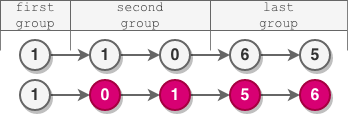
Input: head = [1,1,0,6,5]
Output: [1,0,1,5,6]
Explanation:
- The length of the first group is 1. No reversal occurs.
- The length of the second group is 2. The nodes are reversed.
- The length of the last group is 2. The nodes are reversed.
Constraints:
- The number of nodes in the list is in the range
[1, 105]. 0 <= Node.val <= 105
Hints
Hint 1
Consider the list structure ...A → (B → ... → C) → D..., where the nodes between B and C (inclusive) form a group, A is the last node of the previous group, and D is the first node of the next group. How can you utilize this structure?
Hint 2
Suppose you have B → ... → C reversed (because it was of even length) so that it is now C → ... → B. What references do you need to fix so that the transitions between the previous, current, and next groups are correct?
Hint 3
A.next should be set to C, and B.next should be set to D.
Hint 4
Once the current group is finished being modified, you need to find the new A, B, C, and D nodes for the next group. How can you use the old A, B, C, and D nodes to find the new ones?
Hint 5
The new A is either the old B or old C depending on if the group was of even or odd length. The new B is always the old D. The new C and D can be found based on the new B and the next group's length.
Hint 6
You can set the initial values of A, B, C, and D to A = null, B = head, C = head, D = head.next. Repeat the steps from the previous hints until D is null.