2368. Reachable Nodes With Restrictions
Medium60.2% acceptance85,531 / 142,087 submissions
Asked by 1 company
Topics
There is an undirected tree with n nodes labeled from 0 to n - 1 and n - 1 edges.
You are given a 2D integer array edges of length n - 1 where edges[i] = [ai, bi] indicates that there is an edge between nodes ai and bi in the tree. You are also given an integer array restricted which represents restricted nodes.
Return the maximum number of nodes you can reach from node 0 without visiting a restricted node.
Note that node 0 will not be a restricted node.
Example 1:
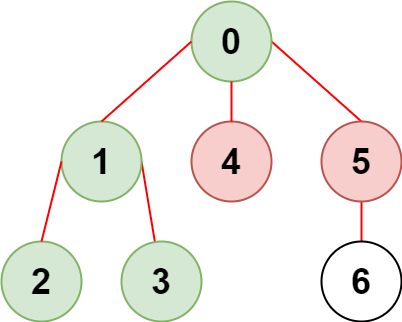
Input: n = 7, edges = [[0,1],[1,2],[3,1],[4,0],[0,5],[5,6]], restricted = [4,5]
Output: 4
Explanation: The diagram above shows the tree.
We have that [0,1,2,3] are the only nodes that can be reached from node 0 without visiting a restricted node.
Example 2:
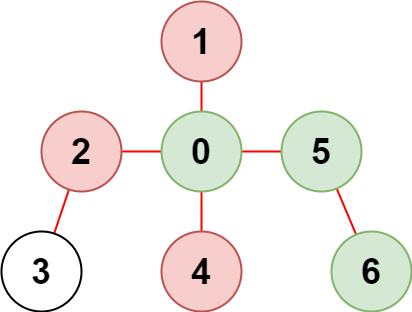
Input: n = 7, edges = [[0,1],[0,2],[0,5],[0,4],[3,2],[6,5]], restricted = [4,2,1]
Output: 3
Explanation: The diagram above shows the tree.
We have that [0,5,6] are the only nodes that can be reached from node 0 without visiting a restricted node.
Constraints:
2 <= n <= 105edges.length == n - 1edges[i].length == 20 <= ai, bi < nai != biedgesrepresents a valid tree.1 <= restricted.length < n1 <= restricted[i] < n- All the values of
restrictedare unique.
Hints
Hint 1
Can we find all the reachable nodes in a single traversal?
Hint 2
Traverse the graph from node 0 while avoiding the nodes in restricted and do not revisit nodes that have been visited.
Hint 3
Keep count of how many nodes are visited in total.