1457. Pseudo-Palindromic Paths in a Binary Tree
Medium68.4% acceptance235,398 / 344,297 submissions
Asked by 2 companies
Topics
Given a binary tree where node values are digits from 1 to 9. A path in the binary tree is said to be pseudo-palindromic if at least one permutation of the node values in the path is a palindrome.
Return the number of pseudo-palindromic paths going from the root node to leaf nodes.
Example 1:
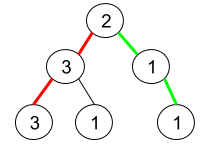
Input: root = [2,3,1,3,1,null,1]
Output: 2
Explanation: The figure above represents the given binary tree. There are three paths going from the root node to leaf nodes: the red path [2,3,3], the green path [2,1,1], and the path [2,3,1]. Among these paths only red path and green path are pseudo-palindromic paths since the red path [2,3,3] can be rearranged in [3,2,3] (palindrome) and the green path [2,1,1] can be rearranged in [1,2,1] (palindrome).
Example 2:
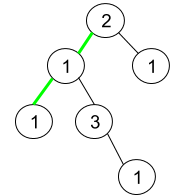
Input: root = [2,1,1,1,3,null,null,null,null,null,1]
Output: 1
Explanation: The figure above represents the given binary tree. There are three paths going from the root node to leaf nodes: the green path [2,1,1], the path [2,1,3,1], and the path [2,1]. Among these paths only the green path is pseudo-palindromic since [2,1,1] can be rearranged in [1,2,1] (palindrome).
Example 3:
Input: root = [9]
Output: 1
Constraints:
- The number of nodes in the tree is in the range
[1, 105]. 1 <= Node.val <= 9
Hints
Hint 1
Note that the node values of a path form a palindrome if at most one digit has an odd frequency (parity).
Hint 2
Use a Depth First Search (DFS) keeping the frequency (parity) of the digits. Once you are in a leaf node check if at most one digit has an odd frequency (parity).