2617. Minimum Number of Visited Cells in a Grid
Hard23.6% acceptance11,776 / 49,878 submissions
Asked by 3 companies
Topics
You are given a 0-indexed m x n integer matrix grid. Your initial position is at the top-left cell (0, 0).
Starting from the cell (i, j), you can move to one of the following cells:
- Cells
(i, k)withj < k <= grid[i][j] + j(rightward movement), or - Cells
(k, j)withi < k <= grid[i][j] + i(downward movement).
Return the minimum number of cells you need to visit to reach the bottom-right cell (m - 1, n - 1). If there is no valid path, return -1.
Example 1:
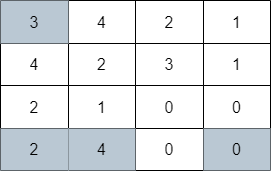
Input: grid = [[3,4,2,1],[4,2,3,1],[2,1,0,0],[2,4,0,0]]
Output: 4
Explanation: The image above shows one of the paths that visits exactly 4 cells.
Example 2:
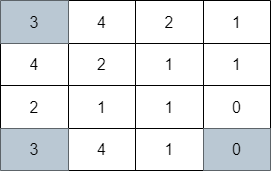
Input: grid = [[3,4,2,1],[4,2,1,1],[2,1,1,0],[3,4,1,0]]
Output: 3
Explanation: The image above shows one of the paths that visits exactly 3 cells.
Example 3:
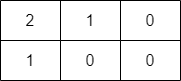
Input: grid = [[2,1,0],[1,0,0]]
Output: -1
Explanation: It can be proven that no path exists.
Constraints:
m == grid.lengthn == grid[i].length1 <= m, n <= 1051 <= m * n <= 1050 <= grid[i][j] < m * ngrid[m - 1][n - 1] == 0
Hints
Hint 1
For each cell (i,j), it is critical to find out the minimum number of steps to reach (i,j), denoted dis[i][j], quickly, given the tight constraint.
Hint 2
Calculate dis[i][j] going left to right, top to bottom.
Hint 3
Suppose we want to calculate dis[i][j], keep track of a priority queue that stores (dis[i][k], i, k) for all k ≤ j, and another priority queue that stores (dis[k][j], k, j) for all k ≤ i.